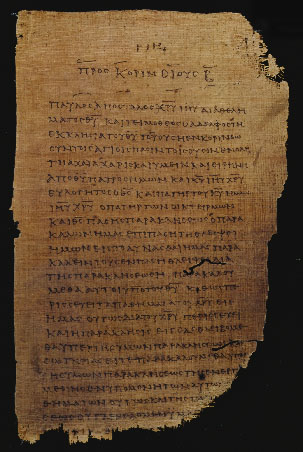
This is Part 2 of a 6 Part series on the text critical paper that I presented at the 2013 SBL Annual Meeting in Baltimore, MD. Here is Part 1. I focused on the textual tendencies of the Ancient Greek manuscript called P46 which is the oldest extant manuscript that we have of Paul’s letters. For more information upon this manuscript see The University of Michigan’s Library andThe Chester Beatty Library.
SUMMARY OF P46 TENDENCIES IN 2 CORINTHIANS
Now that I have examined all the singular readings, at this juncture, I will summarize the tendencies of P46 throughout 2 Corinthians noting (1) its propensity to preserve the original text according to the NU, (2) the types of variants it prefers, and (3) its tendencies to agree and disagree with other MSS.
I. Summary of Preserving the Original
First, as regards P46 preserving the original reading of 2 Corinthians, the NU apparati deem P46 to be original among the variants 76 times out of the 139 variants observed here. This means that according to the NU 54.7% of the time P46 preserves the original reading of 2 Corinthians among the variants. Here is a chart demonstrating this:
|
Chapter |
# of NU Original |
# of Variants |
Percentage |
| 2 Cor 1 |
7 |
18 |
38.9% |
| 2 Cor 2 |
3 |
5 |
60% |
| 2 Cor 3 |
6 |
10 |
60% |
| 2 Cor 4 |
8 |
12 |
75% |
| 2 Cor 5 |
2 |
10 |
20% |
| 2 Cor 6 |
6 |
8 |
75% |
| 2 Cor 7 |
6 |
12 |
50% |
| 2 Cor 8 |
6 |
10 |
60% |
| 2 Cor 9 |
4 |
8 |
50% |
| 2 Cor 10 |
2 |
6 |
33.3% |
| 2 Cor 11 |
6 |
8 |
75% |
| 2 Cor 12 |
14 |
22 |
63.6% |
| 2 Cor 13 |
6 |
10 |
60% |
|
Total |
Total |
Total |
|
|
76 |
139 |
54.7% |
II. Summary of Types of Variants
Second, in regard to the types of variants, P46 changes the original text 63 times among the variants of 2 Corinthians according to the NU. Of these, it tends to have three significant types of recurring variants. First, it changes the grammar and inflection most frequently, 24 times to be exact. Next, it omits words 18 times. Lastly, it substitutes words 12 times. Furthermore, P46 has little propensity to omit phrases, make additions, and alter word order. Here is a chart summarizing the types of variants P46 makes in 2 Corinthians:
|
Type of Variant |
Changes Original |
Preserves Original |
| Grammar/Inflection |
24 |
31 |
| Omission: Word |
18 |
4 |
| Word Substitute |
12 |
12 |
| Omission: Phrase |
4 |
4 |
| Addition |
3 |
13 |
| Word Order |
2 |
12 |
|
Total |
Total |
|
|
63 |
76 |
III. Summary of Agreement with Other Manuscripts
Thirdly, with regard to its agreements and disagreements with other MSS, on the one hand, there are 4 MSS that tend to agree with P46 more often than not, that is, they agree with it 50% of the time or more. On the other hand, there are 14 MSS that tend to disagree with P46 more often than not, that is, they agree with it less than 50% of the time. Those MSS which agree 50% of the time or higher are ranked in this order: Coptic, OL, B, and Ambrosiaster. The MSS which agree less than 50% of the time are ranked in this order: Vulgate, 33, C, 1739, G, A, a, P, Syriac, F, D, 1881, Y, and Majority. Overall, one point is clear: most of the 18 MSS recorded here (77.8%) in this study disagree with P46 far more often than they agree among the variants. Here is a chart that summarizes the agreements, disagreements, and the percentage of agreement that P46 has with other MSS in 2 Corinthians:[1]
|
Manuscript |
Agrees with P46 |
Disagrees with P46 |
% of Agreement |
| a 01 |
65 |
87 |
42.8 % |
| A |
21 |
28 |
42.9 % |
| B |
70 |
65 |
51.9% |
| C |
43 |
50 |
46.2 % |
| D |
68 |
99 |
40.7 % |
| F |
56 |
81 |
40.9 % |
| G |
57 |
80 |
44.9 % |
| P |
26 |
36 |
41.9 % |
| Y 044 |
38 |
85 |
30.9 % |
| 33 |
59 |
68 |
46.5 % |
| 1739 |
61 |
74 |
45.2 % |
| 1881 |
46 |
85 |
35.1 % |
| Majority |
36 |
94 |
27.7 % |
| Old Latin |
67 |
58 |
53.6 % |
| Vulgate |
41 |
43 |
48.8 % |
| Syriac |
30 |
42 |
41.7 % |
| Coptic |
36 |
28 |
56.3 % |
| Ambrosiaster |
23 |
23 |
50 % |
Here is another chart that orders this data from the highest percentage agreements to least from top to bottom:
|
Percentage of Agreement with P46 |
|
|
Manuscript |
% with P46 |
|
Agrees More Than 50% of the Time |
|
| Coptic |
56.30% |
| Old Latin |
53.60% |
| B |
51.90% |
| Ambrosiaster |
50.00% |
|
Agrees Less Than 50% of the Time |
|
| Vulgate |
48.80% |
| 33 |
46.50% |
| C |
46.20% |
| 1739 |
45.20% |
| G |
44.90% |
| A |
42.90% |
| O1 |
42.80% |
| P |
41.90% |
| Syriac |
41.70% |
| F |
40.90% |
| D |
40.70% |
| 1881 |
35.10% |
| O44 |
30.90% |
| Majority |
27.70% |
Now as this relates to textual families, P46 is all over the map. Of the 4 MSS that agree with it most often, there are 2 from the Alexandrian witness, more specifically “proto-Alexandrian,” namely, the Copt. and B.[2] In contrast, there are 2 MSS from the Western type, namely, the OL and Ambrosiaster. So already with those MSS that agree 50% of the time or more, P46 does not consistently align with a certain textual family. Now among the 14 MSS that disagree with P46 most often, 1 is proto-Alexandrian, namely, 1739, and 5 are Alexandrian, namely, 33, C, A, a, and Y. In contrast, 7 are Western, namely, Vg., G, Syr., F, D, 1881, and Majority. While there is certainly more of a stronger dislike of the Western type among those MSS that disagree, all of this data indicates that P46 does not tend to prefer one textual family over the other, but rather would suggest that P46 is inconsistent concerning its agreement with the various textual families.
[1] Note that for this chart I have arbitrarily selected a prerequisite limit of 45 variants or more. This means that only those MSS which have 45 variants or more are on the chart above. If it were any less, then the data would be skewed. As such, the following is a list of the MSS which I examined in this study having less than 45 variants and thus they are excluded from the chart: P34 (0% – 0agr/3dis), P99 (85.7% – 6agr/1dis), Clement (75% – 9agr/3dis), Cyprian (100% – 2agr/0dis), Didache (40% – 2agr/3dis), Eusebius (50% – 2agr/2dis), Irenaus (40% – 2agr/3dis), Marcion (25% – 1agr/3dis), Origen (54.5% – 6agr/5dis), Speculum (50% – 1agr/1dis), and Tertullian (50% – 5agr/5dis). I was not as confident in these due to the fact that they lack the sufficient amount of data for the purpose of this comparative table.
[2] G. Zuntz, The Text of the Epistles (London: Oxford, 1953), 156. Zuntz believes this “proto-Alexandrian” group is composed of P46, B, 1739, Sahidic (Coptic), Bohairic (Coptic), Clement of Alexandria, and Origen.
 Dr. Timothy J. Christian