This is Part 3 of a 5-Part sermon series titled “Liberty and Justice for All” preached at Mt. Gilead UMC in Georgetown, KY. The whole worship service is in the link below titled “Sermon Video,” and the sermon begins at minute marker 6:41. Click here for Part 2.
Gal 3:28; Eph 6:5-9; Col 3:22-4:1
Four Score…
“Four score and seven years ago…” These words immediately evoke in our minds the memory of the great emancipator, the sixteenth POTUS, President Abraham Lincoln. This man is enshrined in American lore as perhaps the greatest President America has ever known. On January 1, 1863, President Lincoln issued what we know today as the Emancipation Proclamation, which proclaimed “that all persons held as slaves…are, and henceforward shall be free.” While the effects of this proclamation were not fully realized until after the Union won the Civil War, the great quest for freedom and liberty for the slaves in America had finally started to see the light at the end of the tunnel. Nine months later, on November 19, 1863, Lincoln gave his most famous speech—the Gettysburg Address—in which he so famously begins:
“Four score and seven years ago our fathers brought forth on this continent a new nation, conceived in Liberty, and dedicated to the proposition that all men are created equal.”
If you don’t remember, a score is 20 years, so 4 score is 80 years then plus the 7 that he adds; and so, Lincoln begins by alluding to the Declaration of Independence, written 87 years earlier in 1776, which states that all men are created equal. Of course, Lincoln and those with him were fighting a fight of definitions: what does “all men” mean in the Declaration of Independence? In his day, African Americans were not considered to be men—humans—but merely someone else’s property. And in this way slave owners and their supporters justified their interpretation of the phrase “that all men were created equal.” African Americans wouldn’t be created equal, if they weren’t even considered to be humans at all. But that was not the conviction of Abraham Lincoln; that was not the correct interpretation according to the great emancipator; that was not what “all men” meant in the Declaration of Independence.
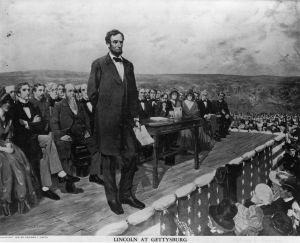
And as we come to the Scriptures this morning, we see too that that is not how God defines “all men” either. Paul declares in Gal 3:28 that in Christ there is neither slave nor free. These four little words have such a full and inexhaustible meaning and impact: “Neither slave nor free.” In God’s eyes, all are one and the same in Christ—rich and poor, slave and free, master and servant. There is no social or economic high ground in Christ’s kingdom—instead, all are one and equal.
…and Seven Days Ago
Last week, we learned about the Bible’s definition of freedom or liberty. We discovered that Scripture talks a lot about freedom and we learned that most of the time it means freedom from the two things that have plagued humanity since the fall of Adam and Eve: that is, freedom from sin and freedom from death. Through the cross, Jesus paid for our sins, and through his resurrection, he destroyed death forever, not just for himself, but for us as well. This is how Scripture defines freedom and liberty—“whom the Son sets free is free indeed” (John 8:36).
But that’s not the whole picture of freedom in the Bible. Yes, there is spiritual freedom from sin and even physical freedom from death in Scripture. But there is also social freedom in the Bible too, a social freedom in Christ that declares that everyone, regardless of social or economic status, are all on the same leveling field in the kingdom of God. Just like there is no ethnic or racial high ground in the kingdom of God, so there is no socio-economic high ground either as Paul declares. And so, this morning, we’re going to delve into exactly what kind of social and economic liberty that God desires for all.
Seven Score…
The evils of American slavery are clear and obvious to us today. I don’t think that any of us would support or condone that type evil oppression today. Seven score and 18 years ago, President Lincoln and the North were not simply fighting evil, racist people in the Confederate South, they were fighting some good—albeit—misguided religious folk as well who claimed that the Bible supported slavery. This, of course, is another sad part of that history, namely, that the Bible was misused actually to support the enslavement of African Americans in America. People in support of slavery saw what they wanted to see in Scripture and fit the Bible into their own worldview instead of the other way around. Perhaps the most misquoted verse was Ephesians 6:5 where Paul commands, “Slaves, obey your earthly masters with fear and trembling.” These words, quoted out of context, were twisted and manipulated to mean that Paul supported slavery and taught that slaves should simply submit to any and all harsh, brutal treatment and beatings for all slaves in all times and places. But nothing could be further from the truth.
When considering Paul’s historical context and even considering the rest of the words that he says here in the remainder of the paragraph, Paul’s statements about slavery, slaves, and slave masters was shocking and unheard of in Paul’s day. Paul was making social and economic leaps and bounds during his day.
First of all, in both Ephesians 6:5-9 and Colossians 3:22—4:1, he gives strong encouragement to slaves. He provides them with God’s perspective on the matter, that in serving their masters and serving with love from the heart, they are really serving Christ. Moreover, he emphasizes to them that the Lord will repay with punishment anyone who causes them harm and will repay with reward anyone who does good for others. And so, we see Paul lifting them up and encouraging them. In fact, Paul says more to slaves in these household codes in Ephesians and Colossians than he does to anyone else. With the one exception of Paul’s commands to husbands in Ephesians 5:25-33, Paul gives more advice and attention to slaves than he does wives, children, fathers, or slave masters. So we see that they were very important to Paul and in turn important to God as well. And so, the amount of attention and encouragement that he gives to slaves is shocking, especially when slaves sometimes were only considered to be property, not real people of any worth or significance.
Secondly and most unheard of is the fact that Paul calls out slave masters and commands them how to treat their slaves. This would have been so shocking to people in the first century. No one told a slave master what to do with their slaves. They owned them and could do as they please with them…but not if they were a Christian. Paul says that Christian slave masters must treat their slaves with respect, dignity, and fairness, for they are those for whom Christ died, their own brothers and sisters in Christ. This was not the way that the world did things, and we see that the Gospel affects us not only spiritually through overcoming sin and physically through overcoming death, but it also affects us socially and economically through how we treat each other as fellow humans. And it is from this point and this perspective that Paul says that there is neither slave nor free. Jesus changes everything. Jesus affects everything—our whole lives are touched, changed, affected, and transformed by the power of his Gospel.
And so, we see that Paul’s words, far from supporting slavery, actually were more about helping those who were stuck in that system, that vicious cycle, and he dared to challenge slave masters and called them to a higher standard, Christ’s standard.
One Hundred Score…
But for us to fully uncover what Paul meant here in these passages, we’ll have to go further back than seven score and 18 years ago during the Civil War time when people misused these Scriptures from Paul. Yes, we have to go back some one hundred score years ago, that is, two thousand years ago to see what exactly slavery was back then. And that’s just what we’ll do next Sunday. But I will say this as a precursor: there are many differences between the type of slavery during Paul’s day in the ancient Roman world and the type of slavery in the early Americas. Yes, slavery is slavery, but not all slavery is one and the same. So next week, we’ll delve more into what the Bible means by social freedom, what the Bible spoke to the ancient world about its kind of slavery, and what it says to the world today about our recent kinds of slavery. Let’s face it, one or two or even three sermons won’t be enough to scratch the surface, but I truly believe that we’ll hear God’s heart for people and how he longs for all people to have spiritual, physical, and even social freedom. It’s all about Jesus. He came to set us free, he has set us free, he is setting us free now, and he will come again to set us free in the most ultimate sense.
And so we are reminded here this morning, that the belief that all people are created equal, made in the image of God, is a Christian, biblical belief more so than an American one. Praise God that Abraham Lincoln, the great emancipator, brought freedom to the slaves in America. But that value was not first a political one, but a Christian one. But more so, we are reminded that liberty—even liberty from slavery—is not just a Christian, biblical value, but is the very desire of God for all people, for Jesus came “to proclaim freedom for the captives” as Isaiah 61:1 says. And we are reminded once again that social liberty is not the child of political correctness and oppression the child of Christians as so many want to espouse today. No, we are reminded that it is a Christian, biblical belief that God loves all, cares for all, protects all, and wants to free all from bondage, whatever kind we may find ourselves in. Moses was sent to liberate Israel from Egypt; Jesus was sent to liberate us from sin and death; and we are sent to bring love and goodness into the world as ambassadors of Christ. And it is in Christ and his love alone when it is shared with others that brings freedom to the heart, freedom to the soul, freedom to the mind, and even from to the body.
My prayer for you this week is that you’d continue to be a beacon of light and love where God has placed you right here, right now; and that through your actions people would know that you’re a Christian by your love. I believe that a major reason why people look down upon Christians today is because we only talk the talk—and sometimes we don’t even do that. But we need to walk the walk and show through our actions and attitudes that we value all people as created in the image of God and that all are equal before God. Let us break the stigmas that Christians were for slavery back then and are for oppression now. Scripture has lit a path for our feet; it’s time to walk that walk. Let’s pray.
 Dr. Timothy J. Christian
One comment